Review of XTAR Li-ion 4150mWh AA / 1200mWh AAA batteries and L8 USB-C 8-bay charger

TL;DR: XTAR’s new lithium-ion AA and AAA batteries offer a decent alternative to Ni-MH rechargeables if weight and/or output voltage is a concern, but only for low- and medium-drain applications. You can charge them directly with 5V if you don’t have a dedicated charger on hand. Their new L8 charger works for their Li-ion 1.5V batteries and third-party Ni-MH cells alike.
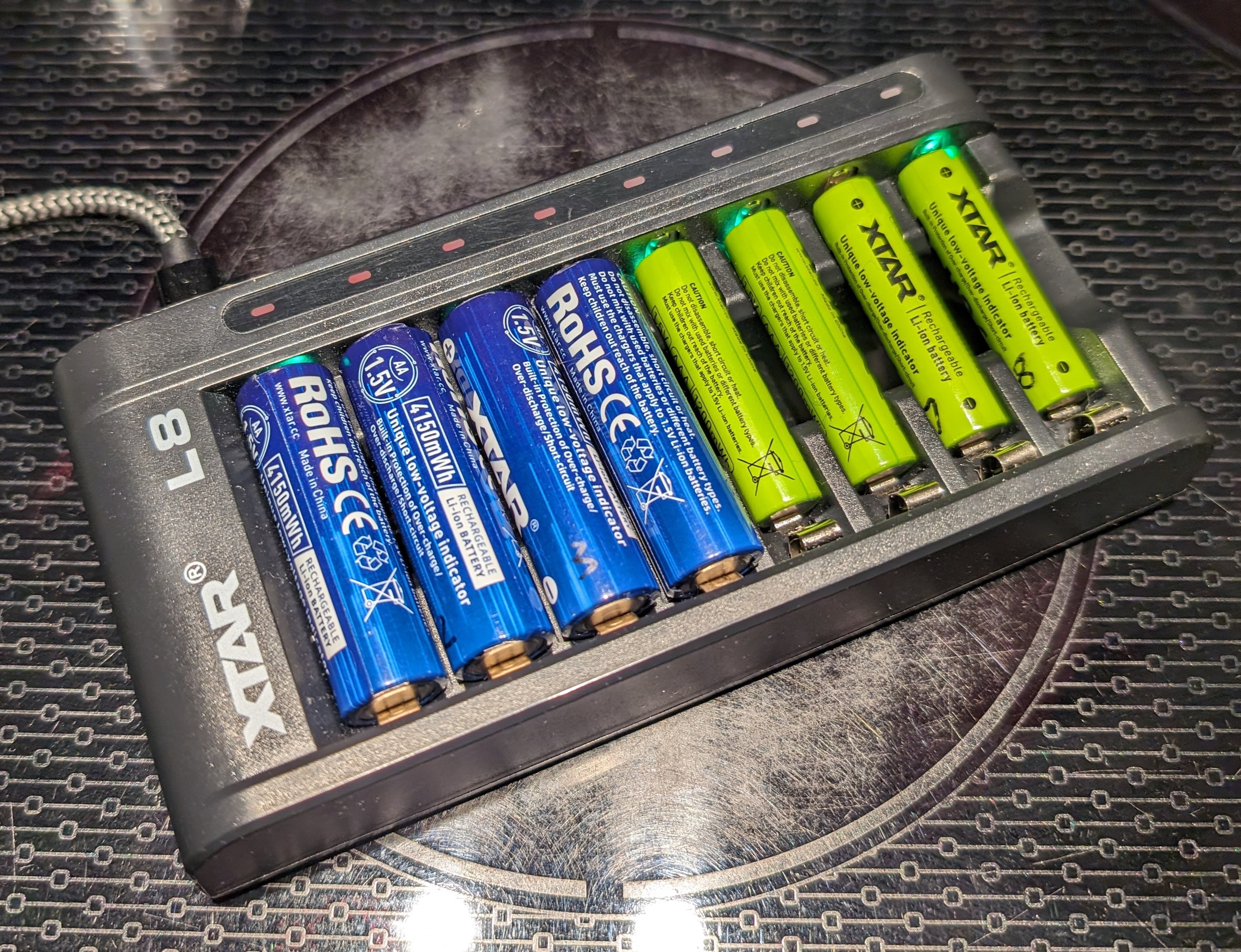
XTAR's 4150mWh AA, and 1200mWh AAA Li-ion batteries in an XTAR L8 USB-C charger.

XTAR’s 4150mWh AA, and 1200mWh AAA Li-ion batteries in an XTAR L8 USB-C charger.

Lithium-ion AA and AAA batteries have been around for several years (see this review of the Kentli PH5 I made several years ago), but that doesn’t mean they haven’t made progress in energy density. Last summer, XTAR offered me a bundle of their latest and highest-capacity AA and AAA Li-ion batteries to try out, alongside their latest L8 multi-chemistry 8-bay charger. After several months of testing, I have collected enough data on which to base my review upon.

FULL DISCLOSURE: XTAR provided these batteries and corresponding charger to me at no charge for an independent review. They had no editorial control over this review, I have not been compensated monetarily, and all opinions expressed in this review are my own.

Introduction

XTAR is no stranger to the world of lithium-ion rechargeable batteries, and their new Li-ion 1.5V AA and AAA batteries offer an incremental improvement to their previous offerings, increasing their AA batteries from 3.3 watt-hours to 4.15 watt-hours of energy, and their 1.2 watt-hour AAA batteries enjoy a small performance boost from 1.5 amps to 1.6 amps of maximum continuous discharge current.

Like all Li-ion 1.5V batteries that use a DC-DC converter internally to regulate the nominal 3.7 volts from the internal cell down to 1.5 volts, XTAR’s AA/AAA batteries feature a flat discharge profile irrespective of load current and state of charge; their better offerings will even reduce their output voltage from 1.5 to 1.1 volts when the batteries near empty, helping to signal to the device they’re installed in that a recharge will soon be necessary; without this feature, a powered device will “think” it’s perpetually at 100% charge until it suddenly turns off.

Some Li-ion 1.5V batteries include charge regulation circuitry internally, which makes charging them easier since you can provide 5 volts from USB power to directly charge them. Some have a (micro-)USB or USB-C port to do this, but at the expense of battery capacity due to the physical space they take up. XTAR gets around this by including a linear charge controller in the positive end cap of the battery, but allows charging by feeding 5 volts into the same terminals used to discharge them. This makes DIY charging of their batteries easy, if one doesn’t want to spend extra for a dedicated charger. That said, the XTAR L8 charger offers multi-chemistry support, charging their Li-ion AA/AAAs as well as your existing Ni-MH cells. You don’t even need to group them by chemistry, as each charge bay is controlled independently – mix your cells to your heart’s content (just not in your device!). If you’ve already converted most of your USB charging gear to USB-C, you’re in luck – the L8 not only supports USB-C adapters with the correct 5.1k pulldown resistors, it supports requesting higher voltages (specifically, 9 volts) using Quick Charge 2.0 over the data pins for faster charge times (something I was unable to quantify since I don’t have enough test equipment on hand).

Battery Tests

For my discharge tests, I used my SkyRC MC3000 multi-chemistry battery analyzer, which was calibrated against my Keysight U1253B multimeter for both voltage and current measurements. Charging the batteries was performed using the L8 charger that XTAR provided me, as the MC3000 doesn’t support charging batteries with integrated charge regulation circuitry. Thermal performance was measured using an Inifiray P2 Pro thermal camera. The results of four cells were averaged together to get the data shown below.

I included tests of Ikea Ladda 2450mAh Ni-MH AA batteries as a means of comparing the performance of XTAR’s Li-ion technology against existing Ni-MH batteries, with the Ladda effectively being a rebrand of Panasonic’s Eneloop low-self-discharge Ni-MH battery.

AA Capacity vs. Load

Testing the battery capacities with varying load currents revealed a “humped” curve reminiscent of my PH5 review; that is, there is a “sweet spot” where the extracted capacity is highest, rather than a simple downward slope for batteries that don’t use an internal DC-DC converter.

Chart showing the XTAR 4150mWh Li-ion AA's capacity at different load currents.

Chart showing the XTAR 4150mWh Li-ion AA’s capacity at different load currents.

The AA battery showed a peak of 2353mAh at 500mA, which might sound like it’s just under the Ladda’s capacity, but things change once we compare the amount of energy that each battery delivers.

XTAR 4150mWh Li-ion AA vs. Ikea Ladda 2450mAh Ni-MH AA

Chart comparing extracted energy from XTAR 4150mWh Li-ion AA vs. Ikea Ladda 2450mAh Ni-MH AA.

Chart comparing extracted energy from XTAR 4150mWh Li-ion AA vs. Ikea Ladda 2450mAh Ni-MH AA.

For these low to moderate loads, the XTAR AA comes out on top, mainly helped by its higher output voltage. This trend only holds true for the load range that the XTAR battery supports, though. Once you need a battery that can support heavier loads, then a high-drain capable Ni-MH battery is your only real option (but given its capacity-vs-load characteristic, it should provide more consistent performance irrespective of load current).

Now, in terms of the above data… I did have to smooth some numbers due to missing energy values, thanks to a bad data collection setup for some earlier data runs; to be more precise, I multiplied the capacity values with a nominal voltage to get the outputted energy values. However, the data trend itself remains the same.

AAA Capacity vs. Load

The AAA batteries have a similar curve to the AAs, but peak at a lower discharge rate relative to its rated maximum discharge current. I didn’t have an equivalent AAA Ni-MH to test against.

Chart showing the XTAR 1200mWh AAA Li-ion battery's capacity versus load current.

Chart showing the XTAR 1200mWh AAA Li-ion battery’s capacity versus load current.

XTAR 1200mWh AAA Energy vs Load

Chart showing the XTAR 1200mWh AAA Li-ion battery’s energy versus load current.

The equivalent nominal voltage is different for the AAA as it decreases to its 1.1V low-battery threshold much later than the AA does. However, its peak energy percentage is also slightly higher than the AA’s but both are in the mid-80% range.

Thermal Performance

Thermal capture of the XTAR 4150mWh AA Li-ion battery at maximum load.

Thermal capture of the XTAR 4150mWh AA Li-ion battery at maximum load.

One potential concern I have with the batteries is just how hot the regulator circuitry at the positive end gets when under heavy loads. While the AA battery is rated for 2 amps of continuous discharge current, the positive end of the battery reached upwards of 80 or 90 degrees Celsius, hot enough to distort the plastic label from the sustained heat. This ultimately isn’t unique to XTAR’s offerings (the Kentli PH5 I previously tested ran into the same issues at high loads), but is still something to be aware of when using these batteries in high-drain devices, especially ones that place a constant load on the battery. The AAAs aren’t quite as affected but still reached temperatures of almost 60 degrees Celsius at maximum rated load.

Thermal capture of XTAR L8 while charging four Ikea Ladda 2450mAh Ni-MH AAs, and four XTAR 4.15Wh Li-ion AAs.

Thermal capture of XTAR L8 while charging four Ikea Ladda 2450mAh Ni-MH AAs, and four XTAR 4.15Wh Li-ion AAs. Note the heat generated at the positive terminal.

In terms of charging, the thermal issue remains but is much smaller. Heating of the positive end circuitry is largely unavoidable due to the use of a linear charge controller (but can you really expect to fit a switched-mode charger in the end cap of an AA/AAA battery?), with peak temperatures just under 50 degrees Celsius. This isn’t terribly hot compared to the peak temperature of a Ni-MH battery near the end of its charge cycle, which in the above image was about 40 degrees Celsius at the time of capture.

Charger Test (Ni-MH Charging)

I was curious as to how the L8 handles Ni-MH charging, so I captured the voltage and currents going into an Ikea Ladda 2450mAh cell with some jerry-rigged AA battery adapters and an AVHzY CT-3 USB meter.

Chart showing the voltage/current of the XTAR L8 while charging an AA Ni-MH cell.

Chart showing the voltage/current of the XTAR L8 while charging an AA Ni-MH cell.

The L8 charges at about 480mA but takes a small pause every 2 seconds to sample the cell’s voltage. Although I can’t say for certain, a zoomed-out look at the test data suggests that the L8 is uses the -dV/dt (voltage sag over time) method to determine when the cell is fully charged.

Conclusion

Overall, I’m quite satisfied with the batteries and charger. While the idea of sticking DC-DC converters inside a small battery case comes with limitations, it can still offer performance benefits for many applications.

Battery Pros

  • Higher output voltage than Ni-MH
  • Higher energy density than Ni-MH (within specified current range)
  • Low-voltage feature drops the output from 1.5 to 1.1 volts when battery runs low
  • Integrated charge circuitry allows batteries to charge directly from 5 volt power (DIY charging is easy)
  • Lack of USB charge port means no space lost to a USB port (therefore, more battery capacity)

Battery Cons

  • Integrated DC-DC converter limits efficiency
  • Heat generation at high loads due to DC-DC converter when discharging, and linear charge regulator when charging
  • Lower maximum discharge current compared to Ni-MH

Performance analysis/review of Kentli PH5 Li-ion 1.5V AA battery

In my previous blog post, I tore down the Kentli PH5 battery – a Li-ion battery that has an internal 1.5-volt regulator that allows for terrific voltage stability… up to a point. In terms of data collection, so far I have collected 55+ runs of data logs (248 MB of text files!) and still do not quite have all the data I want. As for the data that I do have, I will be disseminating them with as much thoroughness as possible.

Updated (May 1, 2018):

The battery’s self-discharge rate experiment has come to its conclusion – click here to read it.

I forgot to add a diagram of my test setup – here’s a Visio diagram of the hardware used to test the battery’s performance… Click here to see the full-sized diagram.

ph5 cycle test setup diagram


Voltage vs. load current

As expected, the voltage output of the PH5 remains quite stable, up until roughly 2.1 amps where the voltage sags noticeably until the regulator goes into overcurrent protection mode.

A maximum load capacity of 2.1 amps seems to be a bit… limiting. That said, I have not done tests on the PH5’s transient load capacity, as it would require more automated control than what I currently have available.

Another issue with having such a flat discharge curve is that any device that performs fuel gauging using voltage alone will report 100% capacity, until it suddenly shuts down. This could be a big problem for digital camera users, as they will have no indication that their batteries are running low, until the device abruptly stops working. If the camera was writing an image to its memory card when the battery died, it could cause the image to be corrupted, or worse, damage the file system on the card!

Voltage vs. state-of-charge

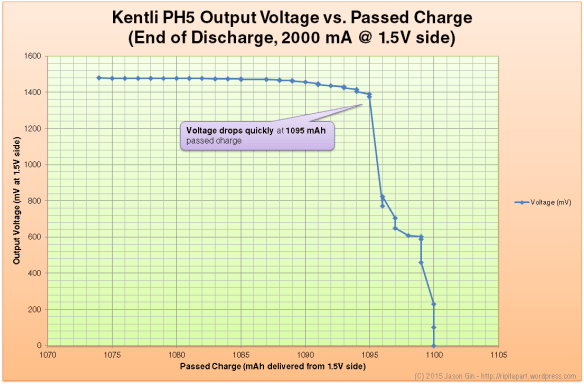
Unless you are running the battery at a high discharge rate, the output voltage will be flat at 1.5 volts before abruptly brickwalling and dropping to zero immediately at the end of discharge. At a high load (in the case of the graph below, at 2 amps), the voltage remains flat until the very end of the discharge cycle (99% depth of discharge for my test run), where it quickly tapers off and drops to zero.

Capacity vs. load

This is the big one, and it took a lot of work to get this data, especially at low loads (48+ hours of continuous logging is just asking for Murphy’s Law to come into play). I used almost 50 discharge runs to create the graph below.

This is where things get… interesting. I was expecting the capacity to peak at low currents then taper off as the load current increases. Instead, I noticed a definite ‘hump’ in capacity around the 250 mA mark (reaching a maximum of 1700 mAh / 2550 mWh), and only after that point did I see the expected downward slope in capacity, reaching 1200 mAh (1800 mWh) at the 2 amp mark.

This data brings forth some very interesting conclusions. The PH5’s capacity is inferior to its Ni-MH counterparts (even the relatively crappy ones), and at higher discharge rates it has similar capacity to that of an alkaline at the same load, albeit with much better voltage stability than the Ni-MH or alkaline chemistries.

Other findings

Although I won’t go into too much detail for the next few points (I haven’t gotten quite enough data to be presentable), there are some other issues with the battery that I think should still be mentioned.

One issue is the amount of heat the battery gives off at high loads. At 2.1 amps, I had to use a fan to blow cool air onto the DC-DC converter just to prevent it from entering its over-temperature shutdown mode. Although the converter itself can tolerate elevated temperatures, the Li-ion cell inside will not; the uneven heating that the cell will encounter could potentially degrade its lifespan in the long run.

Another problem is efficiency. At 1 amp, the DC-DC converter is about 75% efficient, and is only 65% efficient at 2 amps. I have not tested the converter’s efficiency at lower loads yet, but I doubt it will achieve more than 85-90% efficiency.

A potential issue with this battery is self-discharge. The buck converter remains active all the time, unless the converter or the Li-ion protection circuit enters a protective shutdown state. I have not had a chance to fully charge an unmodified battery in order to perform a long-term self-discharge test, but I will create another blog post for that, if/when the time comes. Update (May 3, 2018): See the top of the page for the link to the self-discharge test results.

Conclusion

Overall, I’m on the fence when it comes to this battery. Its innovative design does provide unparalleled voltage stability, but its low capacity even at moderate discharge rates dampens the fun significantly. Additionally, the 2.1 amp discharge limit could prove to be a bottleneck for some high-drain applications; this, coupled with the cell’s tendency to shut down abruptly when the internal cell runs empty could potentially cause file system corruption for digital cameras that have not been designed to handle such sudden power interruptions.

Also, the batteries are very costly. At about $10 per cell, you may want to think twice about replacing all your current disposable and rechargeable batteries with these newfangled Li-ion ones. Don’t forget the charger either, as a special charger is required to make contact with a recessed terminal on the top of the battery.

Overall, this cell is… interesting. Just don’t expect a miracle in a steel can.

Pros:

  • Excellent voltage stability, even at high loads
  • Li-ion chemistry allows for a very lightweight cell, even with the addition of a DC-DC converter
  • High output voltage could allow some devices to run more efficiently

Cons:

  • Low capacity – provides a mere 1200 mAh (1800 mWh) @ 2 amps, and up to 1700 mAh (2550 mWh) @ 250 mA (even alkaline batteries can do better than this)
  • Abrupt shutdown when the battery is overloaded, overheated, or over-discharged
  • Runs hot at high loads (and therefore is fairly inefficient)
  • 1.5 MHz converter and unshielded inductor can cause excessive EMI (electromagnetic interference) in sensitive devices
  • Expensive! Costs approximately $10/cell
  • Requires proprietary charger

Bottom Line: This is a niche product and should not be considered a universal replacement for alkaline or Ni-MH AA batteries.

Teardown of Kentli PH5 1.5 V Li-Ion AA battery

June 17, 2015 – Performance analysis/review HERE!

After having an entire month of dormancy on this blog, I’m finally beginning to cross off the blog posts on my “Pending” list.

Last year, I made a blog post talking about Kentli’s lithium-ion based AA battery that has an internal 1.5 volt regulator. The first order never arrived, and the second one had arrived a few months ago but I never got to actually taking one of the cells apart. That changes today.

Cell overview

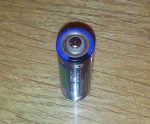
The battery itself looks like a regular AA battery, except for the top positive terminal. There’s the familiar ‘nub’ that constitutes the 1.5 volt output, but also has a recessed ring around it that provides a direct connection to the Li-ion cell’s positive connection for charging.


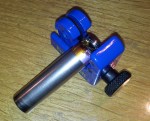
After peeling the label, we are met with a plain steel case, save for the end cap that appears to be laser spot-welded. Wanting to take apart the cell with minimal risk of shorting something out inside, I used a small pipe cutter to gently break apart the welded seam. Two revolutions and a satisfying pop sound later, the battery’s guts are revealed.

Battery internals

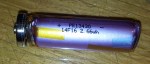
The PCB that holds the 1.5 volt regulator is inside the end cap, with the rest made up of the Li-ion cell itself. Curiously enough, the cell inside is labeled “PE13430 14F16 2.66wh” which is interesting in more than one way. First of all, the rated energy content of the cell is less than what’s on the outside label (2.66 watt-hours versus 2.8), and the cell inside is actually a Li-ion polymer (sometimes called a “Li-Po” cell) type; I was expecting a standard cylindrical cell inside. Unfortunately, my Google-fu was unable to pull up any data on the cell. I might attempt to do a chemistry identification cycle on the cell and see if TI’s battery database can bring something up.

Battery circuitry

The end cap’s PCB uses a Xysemi XM5232 2.5 A, 1.5 MHz synchronous buck converter to provide the 1.5 volt output. According to the datasheet, it is a fully integrated converter with all the power semiconductor components residing on the chip itself. The converter is rated for 2.5-5.5 volt operation, well within the range of a Li-ion cell. Additionally, it has a rated Iq (quiescent/no-load current) of only 20 microamps. The buck converter’s 2.2 microhenry inductor is magnetically unshielded which may cause some increased EMI (electromagnetic interference) emissions, but I don’t have the equipment to test this.

I was looking around for the battery’s protection circuit, and found it on the flex PCB that surrounds the Li-ion cell. It uses a Xysemi XB6366A protection circuit which, like the buck converter, is a fully-integrated device; there are no external protection MOSFETs for disconnecting the cell from the rest of the circuit.

Performance analysis

December 14, 2015 – After extensive and detailed analysis (148 MB of text files!), I’ve analyzed the battery’s voltage and output capacity, which can be viewed HERE (lots of pretty graphs; check it out!).

The data doesn’t stop there. It took almost three years to track the cell’s self-discharge, but the data is finally in. The final report is available here, but previous installments are available here (Part 1), here (Part 2), here (Part 3)here (Part 4) and here (Part 5).

Ramble: 1.5-volt lithium polymer AA battery? What sorcery is this?

Been a while since I’ve posted anything on here, but I decided to share my thoughts on a peculiar AA battery.

This AA battery is the Kentli lithium-polymer AA cell. It has a built-in 1.5 volt regulator that converts the typical 3.7 volts down to 1.5 volts (open-circuit at least). I bought a 4-pack of these cells from AliExpress back in October, but have yet to receive them. Even though I haven’t gotten them, there is some things that I’ve taken note of.

Current/voltage output

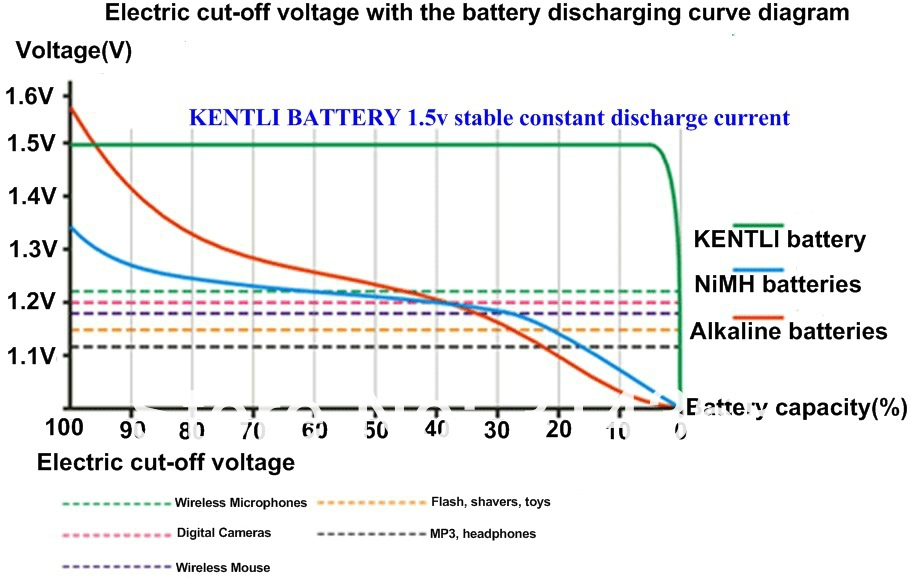
A graph promoting the battery discharge curve of the Kentli cell is shown below, taken from a sales page on AliExpress (rehosted on this blog to prevent image bandwidth-hogging):

705255222_102The interesting thing I found out was the green dashed line. This is supposed to represent the output voltage when used in a wireless microphone. However, the graph itself provides no meaningful data because no current loads are specified at all. In an attempt to get some sort of information from the graph, a Google search for a spec sheet for a typical microphone gives a discharge current of 125 mA. But a 0.3 volt drop at 125 mA? I dunno, this doesn’t seem right.

Safety

From a safety point of view, I’m not sure about how much temperature would rise in the cell from high current draw and whether overheating could occur in use, and if any typical Li-Ion protection circuitry is used (voltage and discharge protection). Given how this is made by some relatively unknown Chinese company, who knows.

I’m not saying anything definite until I see these cells and have a chance to get my paws on them for testing and disassembly. Until then, we’ll just have to wait.